
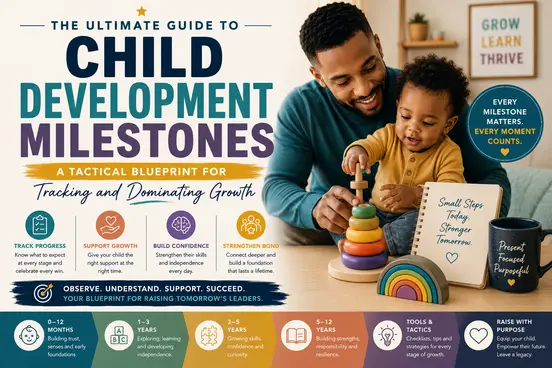
Tracking child development milestones without the stress
Milestones are the skills most children reach by a certain age: smiling, sitting, walking, talking in phrases, playing with other kids. They come in ranges, not on exact dates. Two healthy siblings can walk months apart. The point of tracking is to see the overall direction and pace, not to compare your child with the neighbor’s.
Watch across four areas at once: movement (gross and fine motor), language and communication, thinking and problem-solving, and social-emotional skills. A child can be ahead in one and slower in another. What matters most is steady progress and no loss of skills.
Simple tools that make it easy
You don’t need a spreadsheet. The CDC’s “Learn the Signs. Act Early.” program publishes free milestone checklists by age (cdc.gov/actearly), and the free CDC Milestone Tracker app lets you check off skills, add photos and get reminders. Share it with your partner so you’re both looking at the same picture.
Bring your notes to well-child visits. Pediatricians run developmental screenings at certain ages, and your everyday observations help them. Write down questions as they come up during the week, because you will forget them in the exam room. Our page on tracking and encouraging milestones has printable ideas.
Infants and toddlers: the fast-change years
In the first year, change is visible almost weekly: social smiles, holding the head steady, rolling, sitting, babbling, then pulling up to stand. Between one and three, walking turns into running and climbing, single words become short sentences, and pretend play begins. The infant and toddler milestones page walks through these by age range.
Dads can support this stage with lots of floor time, talking through everything you do (“Now I’m putting on your blue sock”), reading simple board books, and letting toddlers try things themselves, like stacking cups or feeding themselves with a spoon, even when it’s messy.
- Tummy time on your chest or the floor builds neck and shoulder strength.
- Respond to babbling as if it’s conversation; babies learn turn-taking this way.
- Name feelings out loud: “You’re frustrated the tower fell.”
- Offer simple choices: “Red cup or green cup?”
Preschool and school-age development
From three to five, language grows rapidly, and children start telling stories, asking endless “why” questions and following multi-step directions. Emotional regulation is still a work in progress; a four-year-old who can calm down with your help is right on track. See preschool and early childhood milestones for more detail.
During the school-age years, the focus shifts toward reading and math, friendships, teamwork, handling rules and losing gracefully. Kids develop a stronger sense of right and wrong and start comparing themselves with peers. Your role shifts from teacher to coach: help them practice skills, talk through social problems, and keep encouraging effort over results. Our school-age growth and development page covers this stage.
When to ask about a possible delay
Trust your gut. If something feels off, it’s always fine to ask. Talk with your pediatrician if your child is missing several milestones for their age, isn’t responding to their name, isn’t pointing or showing you things by around their first birthday, has speech that is much harder to understand than peers, or seems uninterested in other people.
One sign deserves prompt attention at any age: losing skills a child already had, like words they used to say. Call your pediatrician soon if you notice that.
Remember, an evaluation is a way to get information, not a label. If you’re told to “wait and see” but your concern continues, you can ask for a referral or contact early intervention services yourself.
How early intervention works
Every state runs an early intervention program for children under three, and you can usually request a free evaluation directly without a doctor’s referral. For children three and older, your local public school district is responsible for evaluations, even if your child isn’t in school yet. Your pediatrician or 2-1-1 can help you find the right contact.
Getting help early matters because young brains are highly adaptable. Services might include speech, occupational or physical therapy, often delivered in your home or childcare setting. Dads can be very involved: attend sessions when you can and practice the suggested activities during normal routines like bath time and meals.
If waiting for answers feels heavy, you don’t have to carry that alone. Many fathers in Phenomenal Fatherhood’s community have been through evaluations and therapies with their kids, and talking with them can make the process feel less confusing.
FAQ
Questions dads ask
How do I track my baby’s milestones?
Use the free CDC milestone checklists or Milestone Tracker app, jot down new skills and questions as you notice them, and bring your notes to each well-child visit so your pediatrician has the full picture.
What should I do if my child is behind on milestones?
Talk with your pediatrician and share specific examples. If your child is under three, you can also request a free evaluation through your state’s early intervention program; for three and older, contact your school district.
What is early intervention and who qualifies?
Early intervention is a set of services, such as speech or physical therapy, for children under three who have developmental delays or certain conditions. Eligibility is determined through a free evaluation by your state’s program.
Do boys reach milestones later than girls?
Small average differences exist in some areas, like early language, but they are not a reason to ignore a real concern. Use the same milestone ranges for every child and ask your pediatrician if you’re worried.