
What Father Support Groups Offer
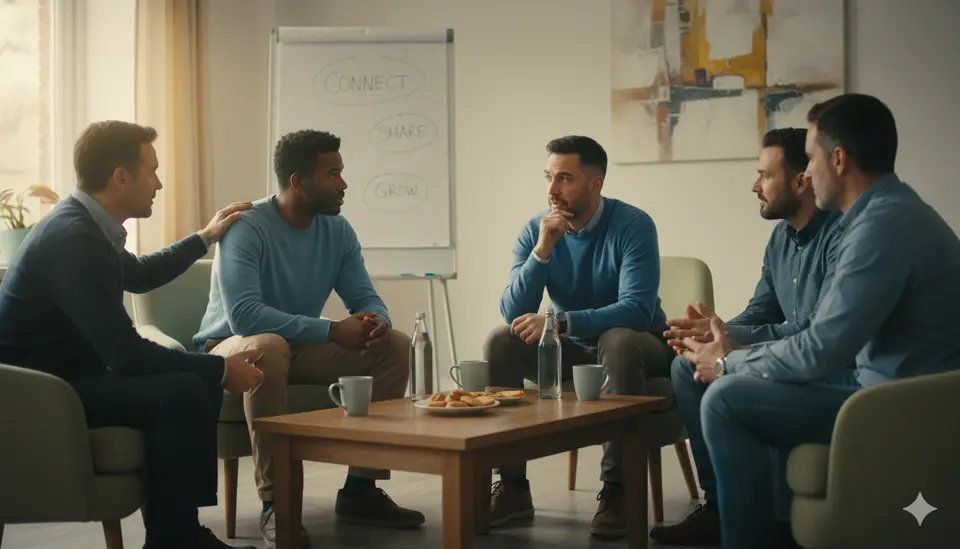
At their best, support groups turn private struggles into shared experiences. Hearing another dad describe the same exhausting bedtime battles or co-parenting conflicts you face is a relief. You realize you are not failing; you are parenting.
Groups also offer practical strategies from men who have tried them, accountability from people who will ask next week how it went, and friendships that last beyond the meetings. Many dads say the biggest benefit is simply having somewhere to say the hard stuff out loud.
- Lower stress from sharing the load
- More confidence from seeing other dads solve similar problems
- New ideas for discipline, routines and communication
- Accountability for changes you want to make
Types of Support Groups for Dads
New and expecting dads
Focused on pregnancy, birth, the newborn months and the identity shift of becoming a father.
Single dads and co-parents
Focused on custody schedules, co-parenting communication and running a household alone. See our single dads support network.
Dads of kids with special needs
Connection with fathers navigating diagnoses, therapies, schools and advocacy.
Grief and loss groups
For fathers dealing with pregnancy loss, the death of a child or other family loss. Often led by trained facilitators.
General fatherhood groups
Open to dads at any stage who want ongoing connection and conversation.
Online vs In-Person Groups
In-person groups offer face-to-face connection and can lead to local friendships and family meetups. They work best if a group meets near you at a time you can attend regularly.
Online groups remove distance and scheduling barriers, which matters for shift workers, dads in rural areas and anyone with an unpredictable schedule. Some dads also find it easier to open up from home. Phenomenal Fatherhood’s online community has discussion and forum areas, and the 24/7 Phenomenal Fatherhood Room is always open for dads to meet and talk. Check out our online forums and communities and the dads supporting dads group chat.
Your First Meeting: What to Expect
Walking into your first group can feel awkward. Most groups start with introductions, maybe your name, your kids’ ages and what brought you there. You can share as much or as little as you want. Nobody expects you to pour your heart out on day one.
Good groups have a few ground rules: what is said in the group stays there, no one interrupts, and advice is offered only when asked. Give it at least three meetings before deciding whether it fits. The first meeting is rarely the best one.
How to Find Father Support Groups
Start online with Phenomenal Fatherhood’s community and the first-time dads support group. For local options, dial 2-1-1 or visit 211.org and ask about fatherhood or parenting groups near you. Hospitals, pediatric offices, community centers, schools and congregations sometimes host or know of groups. The National Responsible Fatherhood Clearinghouse at fatherhood.gov is another resource.
If you cannot find a group that fits, consider starting one. A few dads meeting monthly at a park or coffee shop is a support group. Our local dad meetups page has ideas for getting families together.
Getting the Most From Your Group, Plus Professional Help
Show up consistently. Trust builds over time, and the dads who attend regularly tend to get the most out of it. When you are ready, share something real, even a small struggle. Others will often open up in return.
Listen as much as you talk, and resist the urge to fix other dads’ problems unless they ask. Follow up with someone between meetings if you connected. The friendships that form outside the meeting are often where the deepest support happens.
Peer support is powerful, but it is not professional advice or therapy. If you are dealing with depression, anxiety, addiction, trauma or thoughts of self-harm, please also talk to a licensed professional. Call or text 988 any time for the Suicide & Crisis Lifeline.
Many dads use both: a counselor for deeper work and a group for ongoing connection. Our counseling services page explains how to find professional help.
FAQ
Questions dads ask
What happens at a dads’ support group?
Most meetings include introductions, open discussion or a topic for the session, and time for dads to share challenges and ideas. Confidentiality and respectful listening are usually ground rules.
Are online father support groups as helpful as in-person ones?
They can be. Online groups remove travel and scheduling barriers and some dads find it easier to open up from home. In-person groups offer face-to-face connection. Many dads benefit from either, or both.
How do I find a support group for fathers?
Try online communities like Phenomenal Fatherhood’s, dial 2-1-1 for local options, and ask hospitals, pediatricians, community centers, schools or congregations. Fatherhood.gov also offers resources.
Do I have to talk at a support group?
No. You can listen until you feel comfortable. Many dads attend a few meetings before sharing, and that is completely fine.
What if the first group I try is not a good fit?
Try a different one. Groups vary a lot in size, tone and focus. Some are discussion-heavy, others are more structured around a topic, and some lean toward a particular stage like new dads or teens. Finding the right fit may take a couple of tries, and that effort is worth it.
Can I bring up personal topics like divorce or money in a dads’ group?
Yes, within the group’s ground rules. Many dads find that the topics they were most nervous to raise are the ones others relate to most. Share only what you are comfortable with, and remember a group is not a substitute for legal or financial advice.