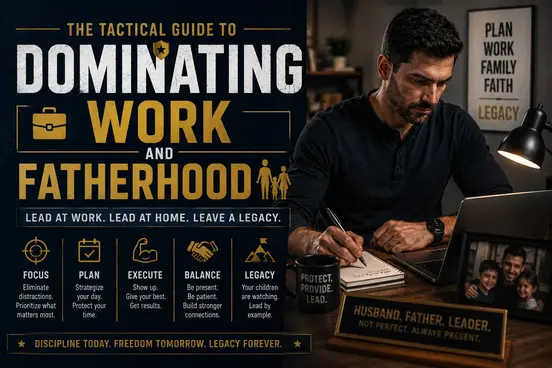

Why emotional bonding for working dads takes a plan
Work has deadlines, bosses and notifications. Family time has none of those, so it tends to get whatever is left over. That isn’t a character flaw; it’s how attention works. Closeness with your children grows from repeated, ordinary moments, and those moments need some protection.
The plan does not have to be complicated. It comes down to three things: a clear line between work and home, a few dependable rituals with each child, and enough rest that you have patience left when you walk through the door.
Draw a clearer line between work and home
Stress travels. If you answer email at the dinner table, your kids see your face change and learn that something on that screen matters more than they do. Start small: pick one window each evening, such as the first hour home, when the phone lives in a drawer.
A short transition routine helps your brain switch roles. Some dads sit in the car for three minutes and breathe before going inside. Others change clothes right away or take a ten-minute walk. Whatever you choose, do it every day so it becomes automatic. For more ideas, see our guide to setting healthy boundaries between work and home.
- Tell your manager which hours you are reliably offline, and keep that promise yourself.
- Turn off work notifications on your personal phone after a set time.
- Put school events, games and bedtimes on your work calendar as real appointments.
Bonding through the early years
With a newborn, connection is physical. Skin-to-skin contact, carrying the baby in a wrap, giving the bath, and doing the late feed or diaper change all count. Babies learn your smell, voice and rhythm through repetition. If you return to work quickly, claim a daily care task that is always yours, such as the bedtime routine.
Toddlers bond through play and through how you handle their big feelings. Floor time with blocks or a chase around the yard builds trust. So does staying calm when your two-year-old melts down because the banana broke. Your steady voice teaches them that big emotions are survivable. Our page on emotional support and bonding has more on these early years.
Staying close with school-age kids and teens
School-age children start facing friendships, rivalries and online life. They need a dad who asks about their day in specific ways (“Who did you sit with at lunch?” beats “How was school?”) and who listens without jumping straight to advice. Help them think through peer conflicts rather than solving them, and set clear family rules for devices. Our guide to online security for kids is a good starting point.
Teenagers often talk most when you’re side by side rather than face to face: in the car, shooting hoops, or cooking. Be available at the odd hours they choose to open up, even if it’s 10:30 on a weeknight. Long hours at work make this harder, so protect at least one predictable block each week that is just theirs.
Daily
Ten minutes of undistracted attention per child: a story, a game, a walk around the block.
Weekly
One longer one-on-one outing, such as breakfast out, a bike ride or a hardware store run.
Yearly
A tradition your child looks forward to, from a camping night to a ballgame.
When work pulls you away anyway
Some seasons are simply heavy: a product launch, overtime, travel, a second job to cover bills. In those stretches, aim for continuity rather than volume. A two-minute video call at bedtime, a voice memo reading tomorrow’s story, or a note in a lunchbox tells your child you’re still thinking about them.
Be honest with your kids about the season. “I’m working late a lot this month, and I miss our Saturday pancakes. When this project ends, we’re doing pancakes and the park.” Then follow through. Children handle temporary absence much better when it is explained and when the promise to reconnect is kept.
Talk with your partner or co-parent, too. A heavy work stretch shifts load onto them, so name it, thank them, and look for ways to carry more once it passes.
Look after the dad doing all this
You can’t be patient on four hours of sleep, no exercise and no one to talk to. Taking care of your health is part of parenting, not a break from it. Short workouts, regular sleep and a doctor’s checkup are basics worth protecting. Our page on parental self-care strategies has realistic options for busy fathers.
Emotional health matters just as much. Older models of fatherhood taught men to stay silent and push through. That approach tends to leak out as irritability. Talking with other fathers helps. Phenomenal Fatherhood’s online community and the 24/7 Phenomenal Fatherhood Room are open for exactly that, and a monthly or yearly membership adds premium resources. If stress has turned into something heavier, reach out to a professional or call or text 988.
FAQ
Questions dads ask
How can a working dad bond with his baby?
Own one daily care routine, such as bath and bedtime, do skin-to-skin contact when you can, talk and sing to your baby, and handle night feeds or diaper changes on your days off. Repetition is what builds the bond.
How do I stop bringing work stress home to my kids?
Use a consistent transition routine before you walk in, keep your phone away for a set window each evening, and tell your kids briefly when you’ve had a hard day so they don’t assume your mood is about them.
How much time do kids really need with their dad?
There is no magic number, but consistency beats length. Short daily moments of full attention, plus a regular one-on-one block each week, give kids a reliable sense that they matter to you.
How do I stay close to my teenager when I work long hours?
Protect a predictable weekly activity together, be available when they choose to talk, use car rides and shared tasks for conversation, and listen more than you advise.